


What if the most important stories in your family aren’t the ones being told, but the ones waiting to be witnessed?
At Root & Seed, we believe meaningful connection begins with something simple: asking, listening, and staying long enough for something deeper to emerge. That belief comes to life in our conversation with Sandy Ho, whose memoir No Way But Through began not as a book, but as a recording between a daughter and her father.
What followed was not just a documentation of family history, but a practice of witnessing that reflects the same intention behind Root & Seed’s conversation cards: to move beyond surface-level exchange and into the stories that shape identity, memory, and belonging. Since its release, Sandy’s book has continued to gain meaningful traction, including being indexed into library collections across Ontario—because stories like hers are not only personal, but part of our shared cultural record.
Casual Beginnings
The project didn’t begin with a clear plan. It began with curiosity.
“I didn’t know the word preservation,” Sandy reflects. “It was more about searching… about trying to understand who I am.”
For years, her recordings lived quietly as something personal. But that changed when her son asked to hear them.
“That was the moment I realized this wasn’t just for me.”
What had been a private exploration suddenly carried weight. Her children weren’t looking for a polished narrative; they were looking for away to understand where they came from, beyond simplified versions of family history. That moment transformed the project from something reflective into something intentional.
Becoming a Witness and Bridge-Builder
A few conversations in, Sandy began to notice a shift in her role. “I realized I wasn’t just the daughter anymore… I was doing something that was both preserving and bridging.”
Her father’s stories, shared in Cantonese and rooted in lived experience, could not simply be recorded and passed along. They needed context. Without it, much of their meaning would be lost on the next generation.
“Even if I translated everything perfectly, there were gaps my son wouldn’t understand.”
This is where her role deepened. She was documenting his stories, but also helping them land.
The Act of Witnessing
At the heart of Sandy’s work is a concept she returns to often: witnessing.
Not documenting in a transactional way. Not extracting stories with urgency. But choosing to be present – without agenda, without needing immediate meaning.
“I’m not watching as an outsider. I’m part of the story. But my posture is just to sit… and be with it.”
In many cultures, especially those shaped by survival and migration, value is tied to productivity and function. There is always a next step, a next task, something to fix or move forward. Pausing can feel unfamiliar, even uncomfortable.
But Sandy challenges that instinct.
“What if I’m not pausing to fix something? What if I’m just pausing because I don’t even know how to smile?”
In that pause, something begins to shift as space is finally created to find meaning.
Finding Legacy in the Everyday
What emerges through this act is a different understanding of legacy.
Not the big milestones, but the quiet, repeated moments that make up a life.
A father repairing something with his hands.
A mother’s steady rhythm in the kitchen.
The unnoticed details of daily routine.
“I wasn’t looking for meaning,” Sandy says. “I just sat… and then I started noticing.”
These moments are easy to overlook precisely because they feel ordinary. But when we slow down, they reveal themselves as deeply formative: Carrying culture, memory, and identity in ways that more obvious stories sometimes do not.
Earning the Story
One of the tensions Sandy navigated was silence. Her father initially resisted sharing, often saying that no one would be interested.
“It takes time for someone to believe that you really want to know.”
Through repeated conversations, follow-ups, and genuine attention, trust began to build. The stories deepened, not because they were pulled out, but because they were given space to unfold.
She also learned that how we ask matters. In some cultural contexts, direct emotional questions can feel misaligned or even uncomfortable. Instead, Sandy found ways to meet her father where he was; sometimes framing questions as practical problems, or choosing formats that allowed more distance, like voice recordings instead of face-to-face conversations.
These small shifts made it easier for stories to emerge naturally.
Translation as Care
Working across Cantonese and English, Sandy came to see translation not just as a technical task, but as a form of care.
“Even when something is translated, it’s already been filtered,” she explains.
By allowing her father to speak in his own language first (and then revisiting, refining, and contextualizing) she was able to preserve more than just the words. She preserved intention, tone, and meaning.
In this way, translation became less about accuracy alone, and more about responsibility: ensuring the story could be received as it was meant to be.
Reclaiming What Was Never Recorded
Sandy’s work also highlights a broader gap, one many families quietly carry.
For those shaped by migration and diaspora, family histories are often underrepresented or missing entirely from mainstream narratives. What exists may feel incomplete, or disconnected from lived experience.
“If this story is worth being read… maybe my story is worth it too.”
Her book offers something many readers didn’t realize they were missing: recognition. A sense that their own family stories (however ordinary they may seem) are valid, meaningful, and worth preserving.
Starting Small
Despite the depth of her work, Sandy is clear that this process doesn’t need to be overwhelming.
In fact, waiting for the “right” story or the “perfect” moment is often what prevents people from starting at all.
Her advice is simple: start small.
Sit for a few minutes. Notice something ordinary. Write it down.
“Then write the boring.”
Because what feels small or insignificant at first is often where the real story begins.
Living the Work, Not Just Writing It
Sandy’s work doesn’t end with the book. It continues in how she is choosing to live.
This spring, she is traveling back to the West Coast with both of her parents, revisiting the places that first welcomed her to Canada as a teenager. But she is intentional about what this trip represents. It is not a book tour or a simple return… it is, in her words, a way of “living out loud.”
She is returning not just to remember, but to witness again. To allow her parents to see the life that grew from those early years, and to reconnect with the people and places that once stepped into the role of “village” when her family could not.
In many ways, it is a continuation of the same work she began with her father: closing gaps, honoring context, and making meaning visible across time.
It is also shaping what comes next. As she looks ahead to a second book, this time her own story, Sandy is beginning to explore what it means to live between cultures, identities, and expectations.
Not as something exceptional, but as something deeply human.
An Invitation to Witness
When asked what she hopes readers take away, Sandy’s answer is simple.
“I want people to read it and think, ‘That’s me.’”
Not necessarily to be inspired—but to recognize themselves. To see their own families, their own moments, reflected back with care.
At Root & Seed, this is the same invitation we hope to extend. Not to document everything perfectly, but to begin. To ask. To listen. To stay.
Because every relationship holds stories waiting to be shared.
_____________________________________
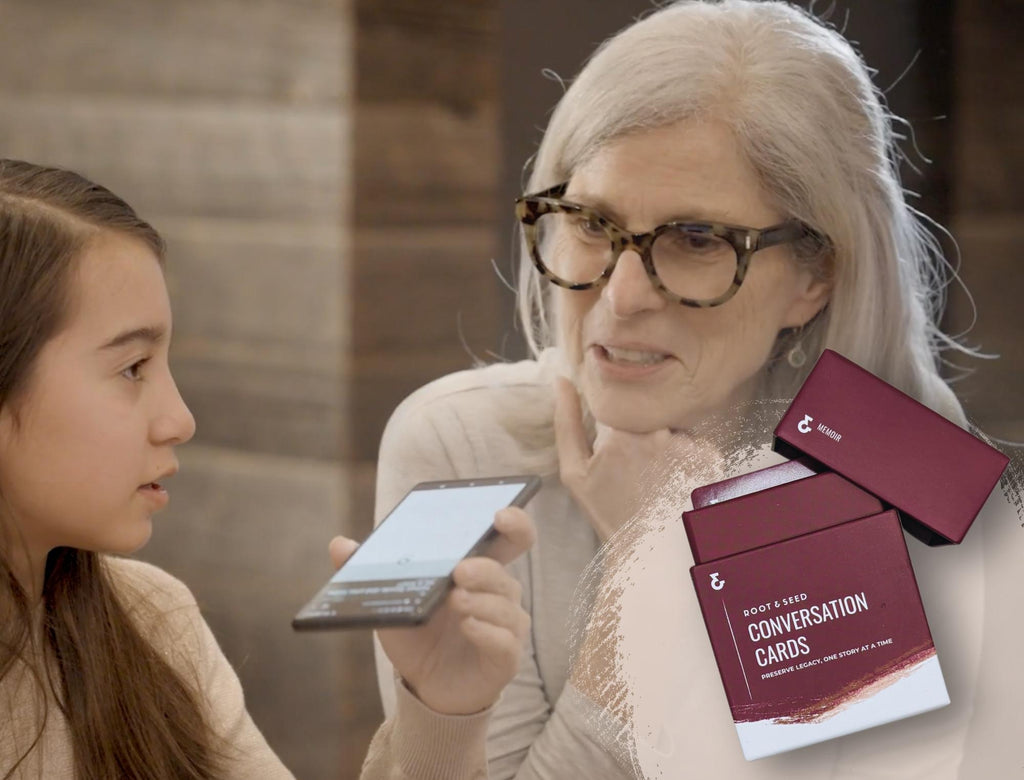
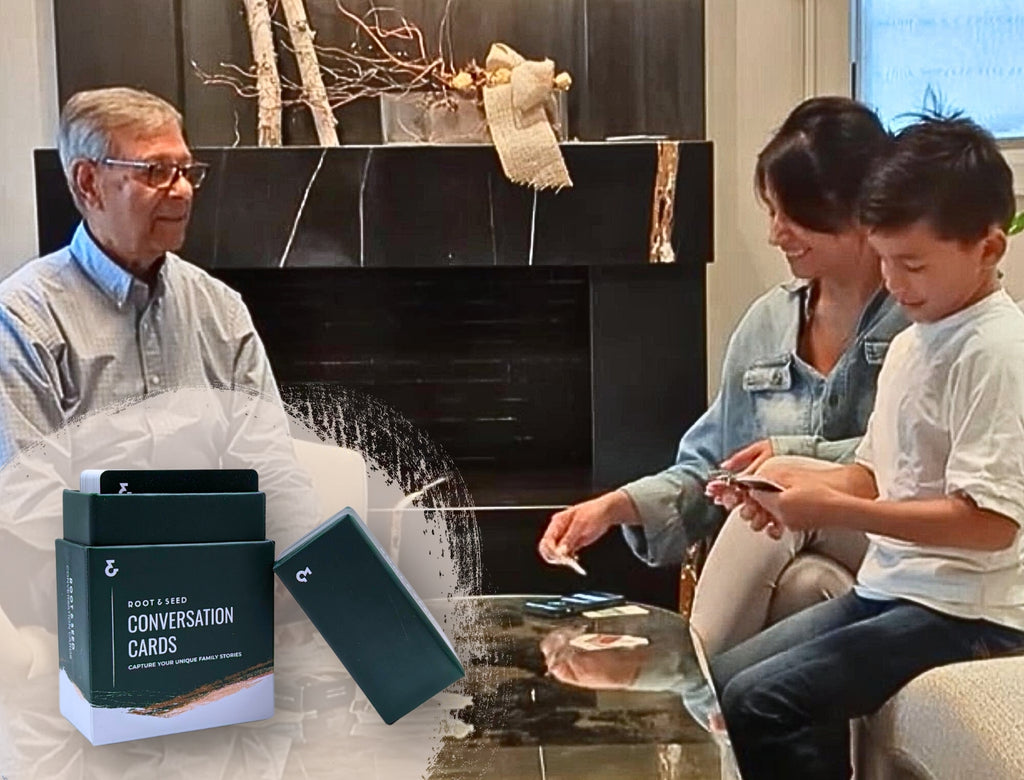
If you’re not sure where to start, our conversation cards are designed to help you move beyond small talk and into the stories that matter most—one question, one moment, one memory at a time.
To learn more about Sandy, visit her website live-out-loud.ca and follow her on social @sandyhowrites


